Dense packing has more than one kind of beauty. Explore twelvefold order, its repeating relatives, and the small-cell record.
Shared motifs, different long-range order
PUBLISHED QUASICRYSTALSource figure
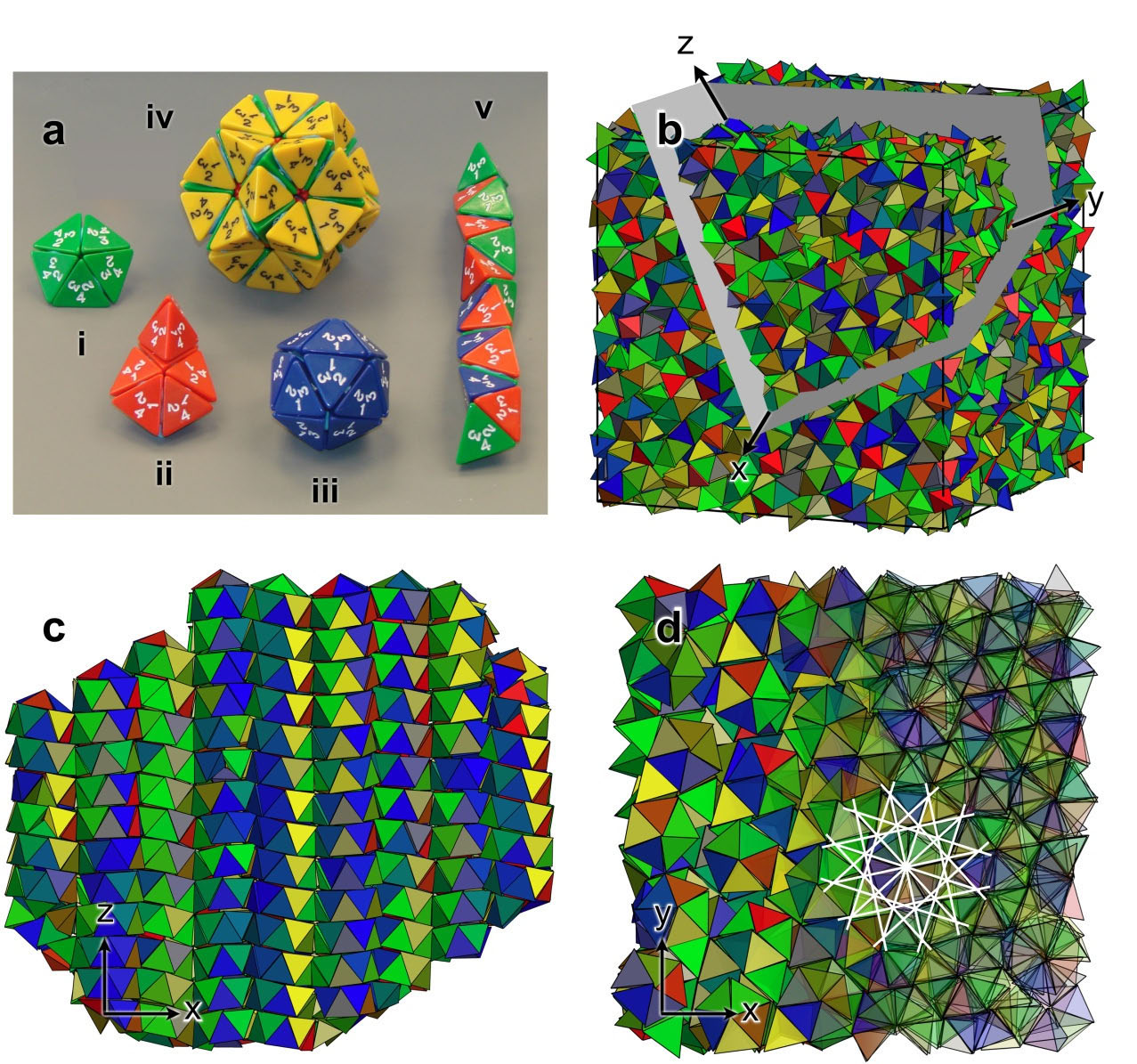
Published comparison · Figure 3 Panel a: quasicrystal network. Panel b: ring and log motifs. Panels c–d: periodic approximant and its tiling. Panel f: similar local pair correlations. Haji-Akbari et al., 2009 ↗
UNIT CELL82 tetrahedraGold outline: reference tetrahedron
Move the solids apart to inspect the unit cell. Their sizes and orientations stay fixed; this is an exploded view.
PERIODIC ASSEMBLYCopy the unit cell into a small block
One unit cell. Assemble seven translated copies to form a two-by-two-by-two block. No inflation or substitution is implied.
Drag to rotate · scroll to zoom through the structure · right-drag to pan
What makes it an approximant?
The approximant repeats a small square–triangle arrangement that retains characteristic motifs of the quasicrystal. It is a periodic relative, not an exact finite piece that becomes the quasicrystal simply by adding copies.
Compare
Quasicrystal
Periodic approximant
Local structure
Twelve-member rings, stacked logs and square–triangle organisation
Related ring/log motifs in a repeating square–triangle arrangement
Long-range order
Aperiodic in the layer plane; periodic stacking
Repeats along all three lattice directions
Diffraction below
Twelvefold pattern (left)
Fourfold pattern (right)
Data shown here
Published figures of the simulated sample
Interactive published 82-particle cell and its translated copies
No synchronized 3D overlay is available: the full quasicrystal coordinates are unavailable. The source panels provide the direct geometric comparison; the interactive model lets you inspect the approximant separately. Similar pair correlations describe local resemblance, not equality of the structures.
THE TELLTALE DIFFERENCE
Similar neighbours. Different long-range order.
The quasicrystal has twelvefold diffraction. Its approximant breaks that symmetry to fourfold. Local resemblance does not imply global repetition.
Published Supplementary Figure S6. Left: quasicrystal. Right: compressed approximant. Haji-Akbari et al., 2009.
A DENSITY DETAIL
The cell is not the record.
The interactive approximant uses the paper’s published 82-particle cell, at 84.7866%. The reported 85.0267% result came from separately compressing an eight-cell, 656-particle supercell. Simply repeating these 82 coordinates does not reproduce that higher density.
The original ideal starting cell and time history are not included in the available coordinate data. The exploded view separates the endpoint solids for inspection; it does not reconstruct the authors’ relaxation. Its underlying vertex arrangement is \((3,4,3^2,4)\). Coordinates and supplementary notes ↗
ANOTHER APERIODIC ROUTE
Icosahedral order.
Fang and colleagues proposed a different regular-tetrahedron quasicrystal, built by decorating a three-dimensional Ammann tiling. Its reported density is 59.783%. It is a useful example of choosing symmetry and aperiodicity over maximum density.
For hard tetrahedra, the 2011 phase-diagram study found the approximant more stable than the denser dimer crystal below about 84% packing fraction. Entropy makes structure selection richer than a race to fill every gap.